Only a few are chosen…

The bloom is almost over.  We have a few late apples (Rome Beauty) planted in the low spots that are still blooming, but for the most part, bloom is over and the bees have done their work.  We were worried about the number of native bees in the orchard this year, but once again, we see a pretty good “set.”  Now we turn our attention to thinning.

Thinning is the process of selectively removing all but a few of the tiny fruits so that the remaining fruit will achieve good size and color.  The earlier we complete the thinning process, the more time that the tree can focus its growth on the remaining fruit, resulting in higher quality.
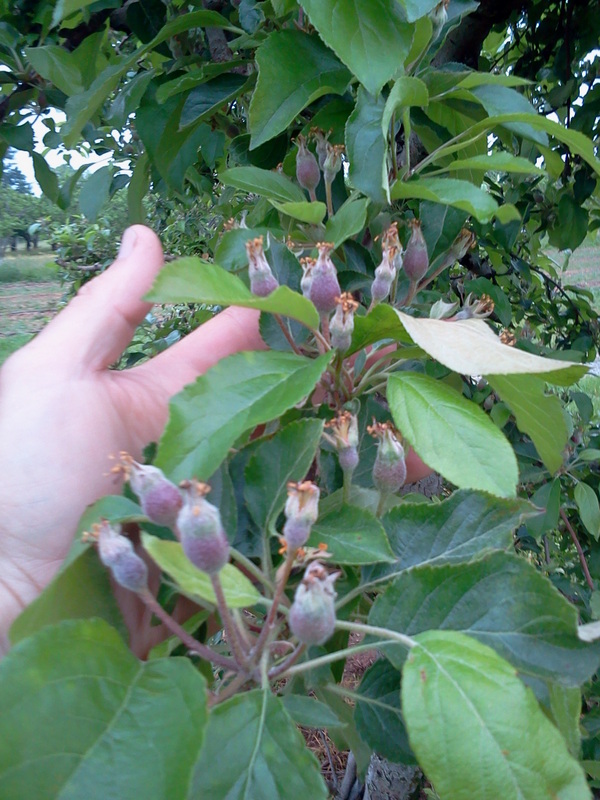
Apples that need to be thinned.

Apples that need to be thinned.

For example, in the picture, taken today in our Gala block, you can see the results of that beautiful bloom.  Each ‘spur’ on the tree usually results in 4-6 blooms.  The center bloom is the “king” bloom and will have the largest fruit.  With even a 50% pollination rate, there are so many apples on the tree that if left untreated, the fruit would be small, and likely not develop uniform color because it would be shaded by its neighbors touching it.  In extreme cases, the growing process could even knock the apples off the tree as neighboring fruit jockeys for space.

In peaches, we start the thinning process even before the blossoms are pollinated.  The process is called blossom thinning and has only recently become mainstream.  Basically, the process involves knocking off about half of the blooms before they ever have a chance to develop.  Growers have developed some creative ways to blossom thin: from cordless drill-mounted wirlygigs, to tractor mounted whips that knock off blossoms, to the more manual hand-work.  No matter which method is used, the timing is critical as the blossoms only last a short while.  If the job is not done well, hand thinning will be necessary later in the season, with decreased quality and increased cost.  If thinning is not done at all, the grower is almost guaranteed an unsaleable crop.

In apples, the thinning process is more automated, but nearly an art form.  Almost all apples are thinned using sprays that are applied at exactly the right time at exactly the right quantity.  The calculus used in the decision process includes a lot of notes as to how those trees have reacted in the past to thinning, and also includes careful consideration of not only the current weather, but the weather forecasted over the next several days.  It turns out that more apples will drop if the weather will be cloudy and warm, and fewer will drop if the weather will be sunny and cool.  Scientists at Cornell have developed a model to codify these observations, but there is still a lot of room for error.

All these variables make apple thinning a pretty stressful time around the orchard.  This week’s forecast seems to have a lot of uncertainty with a forecasted easterly flow off the ocean that could lead to nearly constant cloudy weather with showers, or perhaps partly sunny skies with warm temperatures.  The difference could be significant for thinning.  Only time will tell.
 

…Bet you wish you were outside this week

In case you missed it, the weather this week was fabulous.

Fruit Growers, like all farmers, spend a lot of time outside.  If you have to work outside a lot, you tend to really appreciate it when it isn’t really hot, cold, wet, or windy.  This was one of those weeks when it was pretty near perfect.

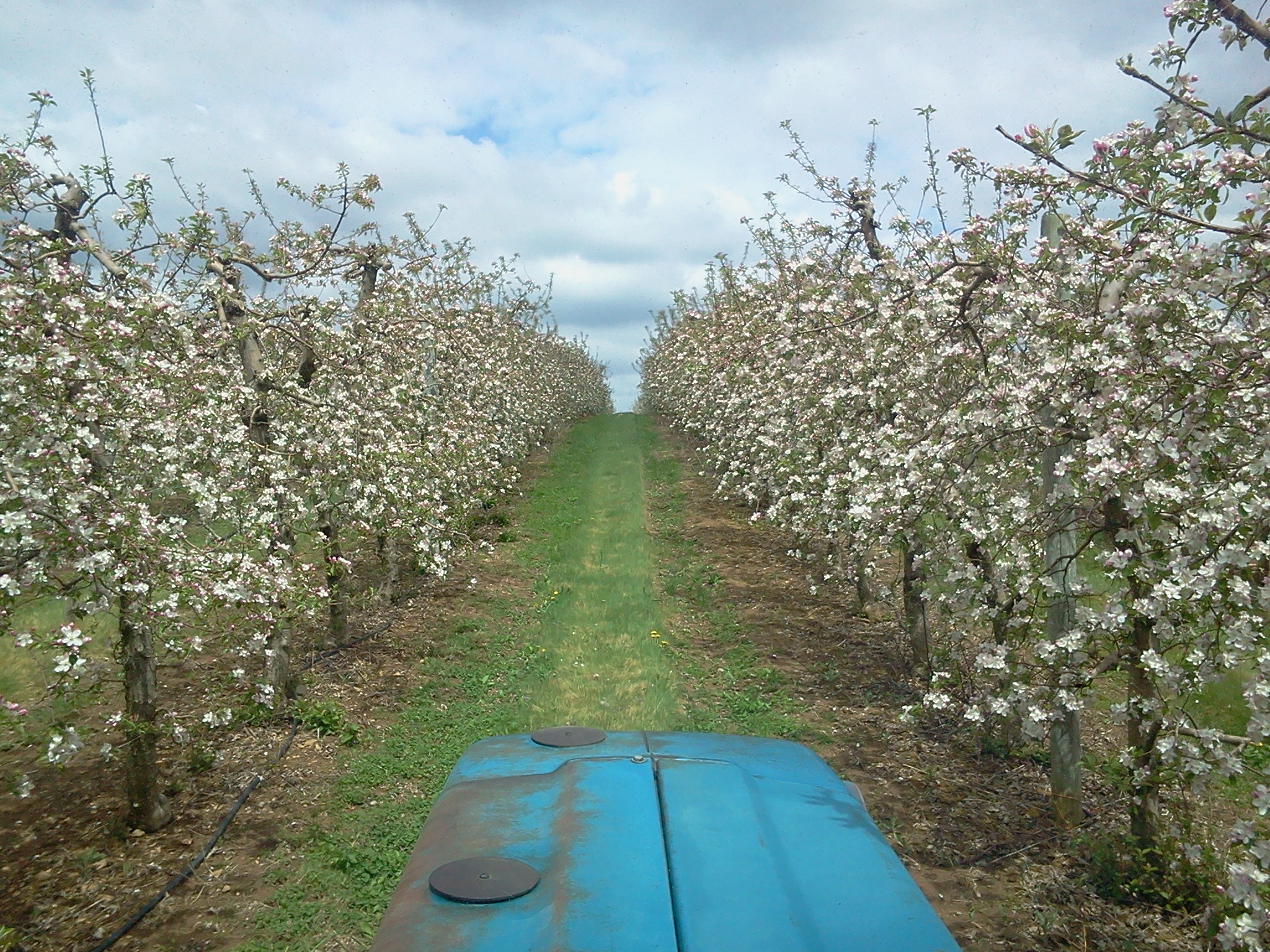
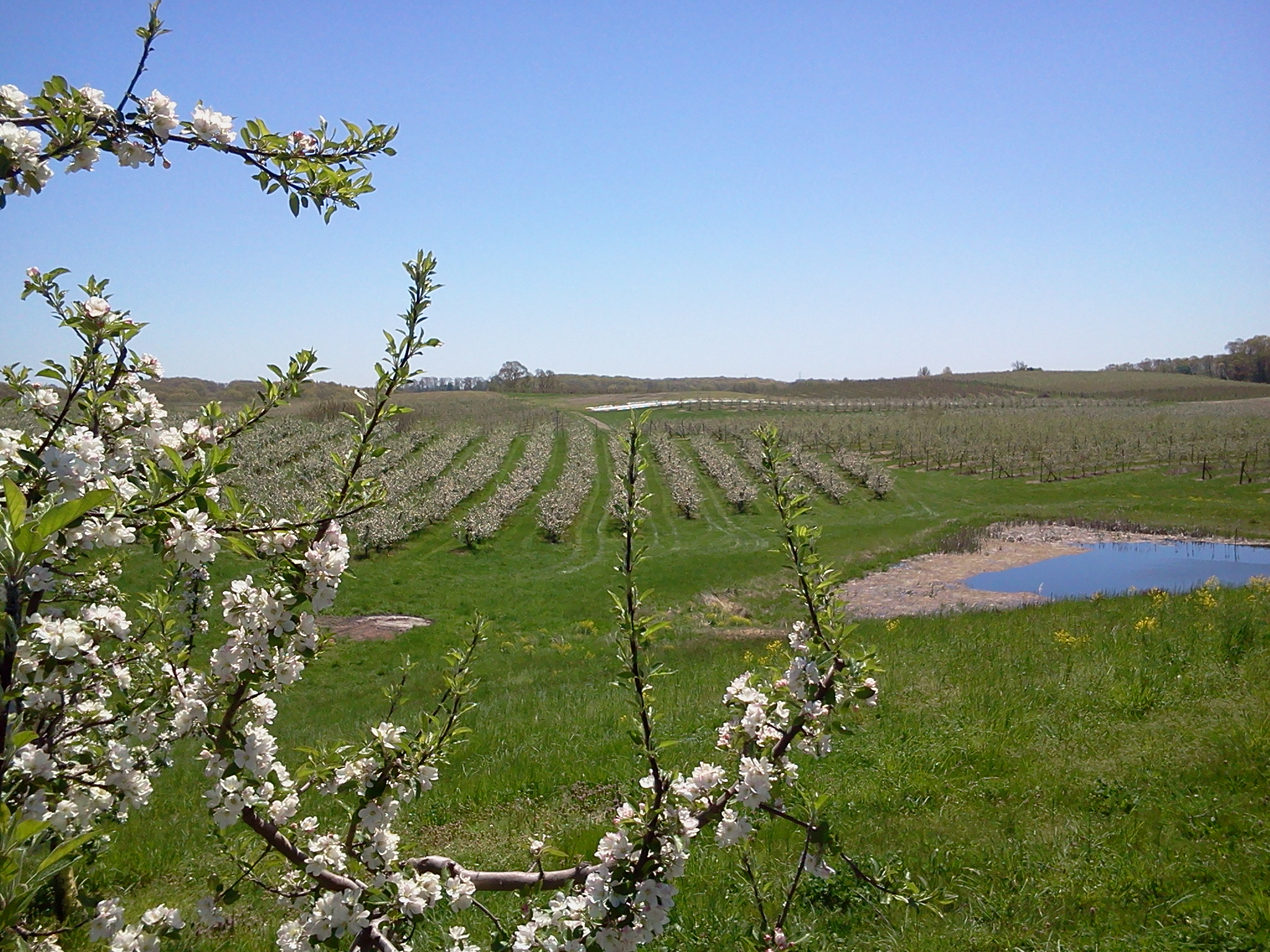
It was also the week the majority of our orchard reached full bloom.  All of our apple varieties have reached peak bloom except for the Rome Beauty, which are always last.  Our Red Delicious has had an exceptional bloom.  Posted here are some of the pictures I took while working this week out in the fields.  Apple Bloom

What the pictures don’t capture is the scent.  Apple blossoms are wonderfully fragrant, and when you put a million of those flowers in one place… well, it is kind of nice!

There is one other sense that you probably wouldn’t expect to be exercised in a blooming orchard.  It is the sound of bloom.  All of those little flowers are really there not for our enjoyment, but to fulfil the biological imperative of reproduction, and they need help.  The sound comes from all of the insects that find their way to the orchard and play their part in nature’s cycle.  Funny enough, the sound of these creatures has changed through the years.

We used to import domestic honey bees, but this has become increasingly expensive.  When I was young, we’d have dozens of hives around the orchard for a couple weeks and there was a constant droning sound in the apples.  But these days we rely more on native insects.  We are very (very) careful about the chemicals we use, and so far we’ve seen good results from all kinds of insects that you would normally not notice.  Bumblebees are the most conspicuous, but we see lots of smaller bees, flies, and other insects too.  They have a more diverse, and softer sound.

Hopefully they’ve been enjoying this nice weather too!

Yes, that's the front of a Ford tractor!

Saved by the dawn

It goes without saying that farming of any sort involves a lot of risk.  Those of us growers in the fruit industry incur a little more risk than normal.  We have the same commodity and market risk as other growers, but I’d contend that we have a higher risk of weather related events.

First, there’s drought which can affect all farmers.  2012 will long be remembered by those in the midwest for the record setting drought there.  It drove grain prices sky high as the markets gradually realized that despite a record-setting acreage for corn, the yields would be mediocre at best.  (It actually turned out to be the 7th highest total yield.)  Many of our neighbors here in the East will forget that we also had a short drought here.  It caused us a great deal of mortality in a newly planted field of strawberries, which will probably take us an extra year to recover.

On the flip side of drought, is too much rain.  You’ll rarely hear a grain farmer complain about too much rain, but fruit growers fret over it.  Rain brings conditions favorable for disease that can disfigure fruit or even kill a tree.  We work hard to use varieties and methods that prevent disease, but the most effective tool is timely application of fungicides.  Which means that fruit growers are constantly watching the weather to try to prevent disease before it starts to rain.

Our most dreaded weather foe is undoubtedly hail.  Two minutes of hail in a violent thunderstorm can completely destroy a crop.  And not just one fruit type – but everything in every orchard.  And since thunderstorms strike in the summertime, it means that all of the costs are already sunk and there is no way to retrieve them.  If you’re already in debt, a hailstorm can knock you out of the game for good.

Finally, there is the spring freeze.  All fruit trees go through a blooming phase, where they are especially vulnerable to cold weather.  If we experience freezing temperatures for more than a few hours during bloom, we begin losing the crop.  Chances are good you didn’t realize that after the big front brought us needed rain last Friday, that the resulting northly winds on Saturday ushered in freezing conditions for much of Pennsylvania.  I awoke this morning and checked my thermometer right away: 32.9.  I later took a look at the climate conditions page for PA, and watched an animated map of Pennsylvania temperatures Saturday night.  By 4:00 AM the freezing temperatures were nearing Adams County and by 6:00 AM they were in York County, but just as they neared us…  the sun rose.

Today, we were saved by the dawn.  Hopefully, our luck with the weather will continue for oh, another seven months!


The spring bomb finally went off!

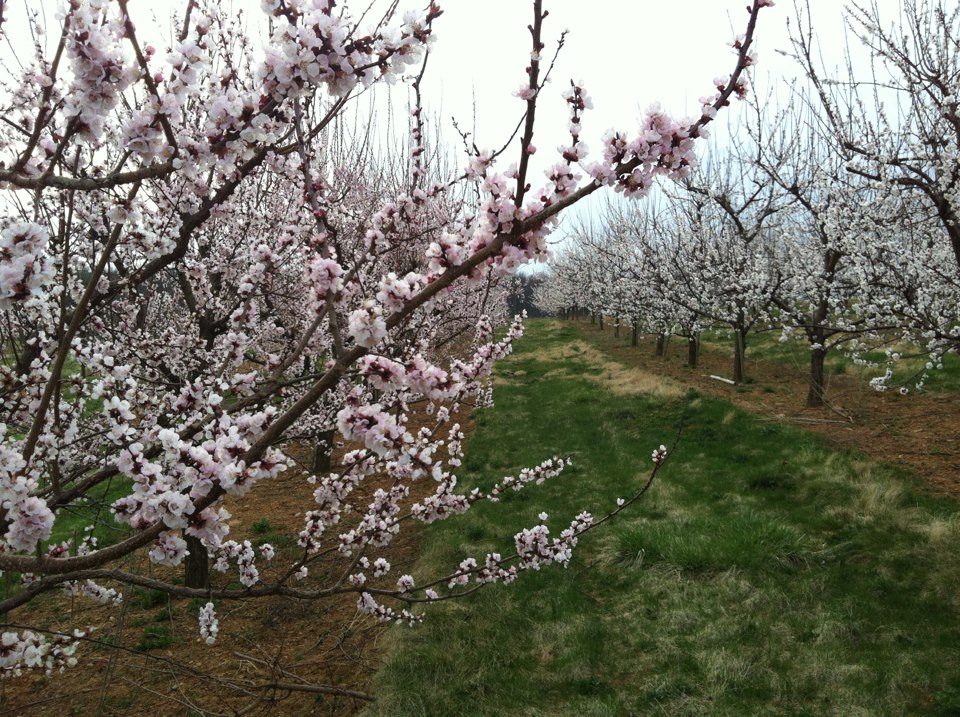
Our apricot block on Tuesday 4/16.

Our apricot block on Tuesday 4/16.

If you had told me last weekend that we’d have peaches in bloom in 4 days, I wouldn’t have believed it.  The usual pattern of bloom in our orchard is pretty simple: apricots come first and last for a few days, followed by a few days of plums, followed by a few varieties of peaches.  But this year, thanks to a record high temperature on Wednesday (90!) we experienced the whole cycle in 3 days.  Apricots were in full bloom Tuesday, plums on Wednesday, and our first peaches were blooming Thursday.  Wow!

Bloom has a big impact on the orchard.  First of all, it means that it is time to be done pruning (we’re not).  It means that the trees are highly vulnerable to disease from any passing shower (we had a 30 hour wetting period on Friday causing us to scramble to provide protection).  It means that we have a very narrow window of opportunity to try to blossom thin our peaches in order to reduce the hand thinning work that will need to be done later in the season.  And it also means that anything we are going to plant needs to be in the ground very soon, which means we are spreading lime, fertlizer, and marking rows.  Throw in two flat tires, a broken drive belt on the sprayer, and a few other mechanical issues, and needless to say, it was a really busy week.

With all of this work going on, it is easy to miss the beauty around us.  I was thinning some peach blossoms by hand when it occured to me that… well, it was a really “pretty” job.  Heck, some people might even pay to stand in an orchard of blooms on a bright sunny day and run their hands across the limbs to knock off a few flowers!

The weather forecast calls for a little more seasonal weather this week, which is fine with me.

I’d like to stop — ok, maybe just slow down — and smell the flowers a little, before they are all gone.

Every Day is Different

I’ve just completed my first full week of work on the farm.  This is the time of the year when there is a lot of…  hurry up and wait.  As I mentioned before, our pruning is a little behind schedule, but so is spring.  In fact, it was 19 at my house earlier this week.  So we aren’t too stressed about the pruning progress.  It looks like all will be done in time.

As I was out in the field this week catching up on the pruning progress, I noticed something white down at the big pond.  Many of you hunters out there know the sensation…  there is something down there that isn’t always there: it must be an animal.  White at the top, white at the bottom, brown in between and standing at the edge of the pond.  Sure enough it was a big eagle.  I continued on my path which came close to the pond and the eagle rose up into a locust tree as if to show off.  He was immense, and unafraid.  Hopefully he found one of those muskrats that have been digging in the bank. This is exactly the kind of thing you don’t get to see while working in an office.

There are a lot of things I know I’m going to love about this new adventure.  And the best part is that I don’t even know what all those things will be.  Because every day is different.


Waiting for Spring

Today is March 24.  Last year at this time, I believe our peaches were blooming after the warmest winter in memory, and we were worried sick that a return to a normal weather pattern would bring a freeze that would surely wipe out our crop.  In fact, that is exactly what happened to our friends in Michigan, New York, and even just a hundred miles north of us.  Michigan lost something like 90% of their cherries, and almost all of their apples; it was the most impactful freeze in decades causing prices to spike and buyers to scramble for supplies.  So despite a short cherry crop for us, things turned out OK after all.  Dad always said it was better to be lucky than good.

But that was then.  This year has been abnormally cool, and strangely enough, most fruit farmers are OK with that.  It means that the odds are a little better in  our favor.  Because when things really do thaw, there is a lower probability of a cold snap while those blossoms are in a delicate state.

The cool weather has also given us a chance to finish pruning.  In the winter, we prune our apple trees to remove all of the growth that has occured in the “wrong’ places.  Apples grow best when exposed to sunlight and only by vigorous pruning can we keep them sunny.  We’re running a little behind this year and welcome the extra couple weeks of dormancy.  Once the buds begin to break, we’ll be on Mother Nature’s clock and will need to move quickly to the next phase of fruit production: thinning and disease prevention.  But I’ll talk about that later when we’re in that season.

For now, we’re thankful for the extra time off.